Underwriting & credit
Rent-to-Income Ratio: Definition & Example
Also called: Income-to-rent ratio
What Is a Rent-to-Income Ratio?
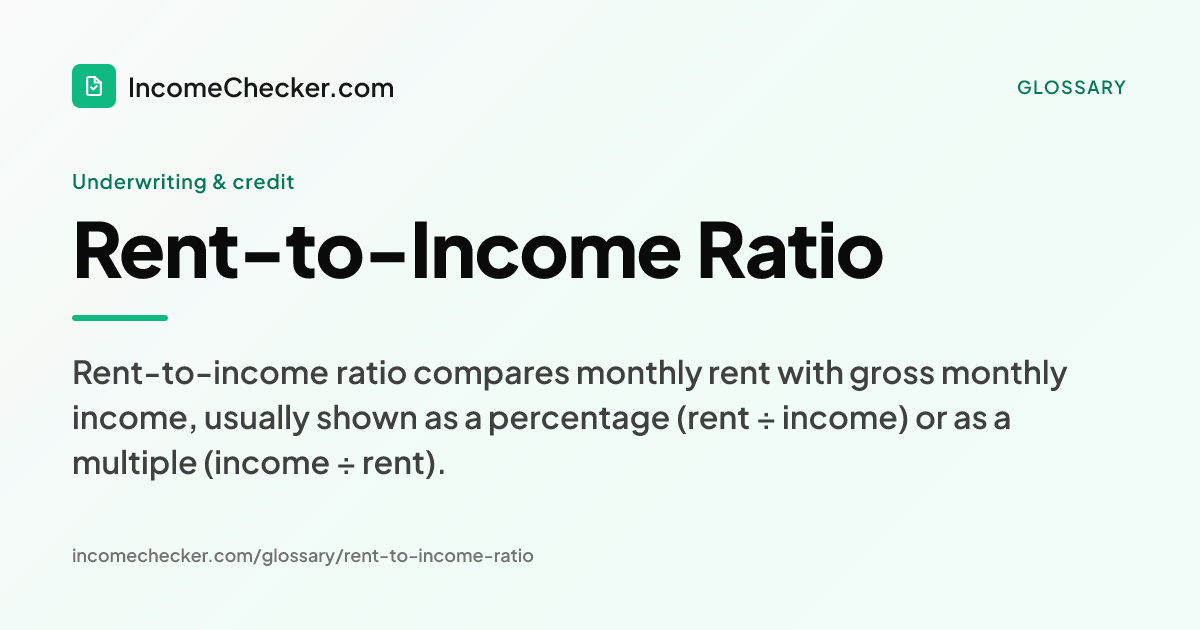
Rent-to-income ratio compares monthly rent with gross monthly income, usually shown as a percentage (rent ÷ income) or as a multiple (income ÷ rent).
What does rent-to-income ratio mean?
Expressed as a percentage, rent-to-income is monthly rent divided by gross monthly income. Rent of $1,500 on income of $5,000 is 30%. Expressed as a multiple, it is income divided by rent, which is 3.33x in the same example.
Landlords commonly want rent at or below 30% to 33% of gross income, which is the 3x rent rule. Households paying more than 30% of income for housing are considered cost-burdened under HUD’s definition, and those paying more than 50% are severely cost-burdened.
The ratio does not account for other debts, household size, or savings, so some landlords look at residual income or debt-to-income ratio as well.
Rent-to-income ratio example
An applicant earns $4,200 gross per month and applies for a $1,350 apartment. Her rent-to-income ratio is $1,350 ÷ $4,200 = 32%, or an income-to-rent multiple of 3.1x, which meets a 3x requirement.
Related terms
- 3x Rent RuleThe 3x rent rule is a common landlord guideline requiring an applicant’s gross monthly income to be at least three times the monthly rent.
- Debt-to-Income RatioDebt-to-income ratio (DTI) is the percentage of a person’s gross monthly income that goes toward monthly debt payments, including housing, car loans, student loans, and minimum credit card payments.
- Front-End RatioThe front-end ratio is the percentage of gross monthly income that goes toward housing costs: mortgage principal and interest, property taxes, homeowners insurance, and HOA dues or mortgage insurance.
- Gross Monthly IncomeGross monthly income is the total amount a person earns in a month before taxes, retirement contributions, insurance premiums, or other deductions are taken out.
- Residual IncomeResidual income is the money left over each month after paying major obligations such as housing, debt payments, taxes, and basic living costs. The term also refers to passive income that keeps arriving after the initial work.
Rent-to-income ratio FAQ
- What is a good rent-to-income ratio?
- Many landlords and budget guidelines aim for rent at or below 30% of gross monthly income.