Underwriting & credit
Front-End Ratio: Definition & Example
Also called: Housing ratio, PITI ratio
What Is a Front-End Ratio?
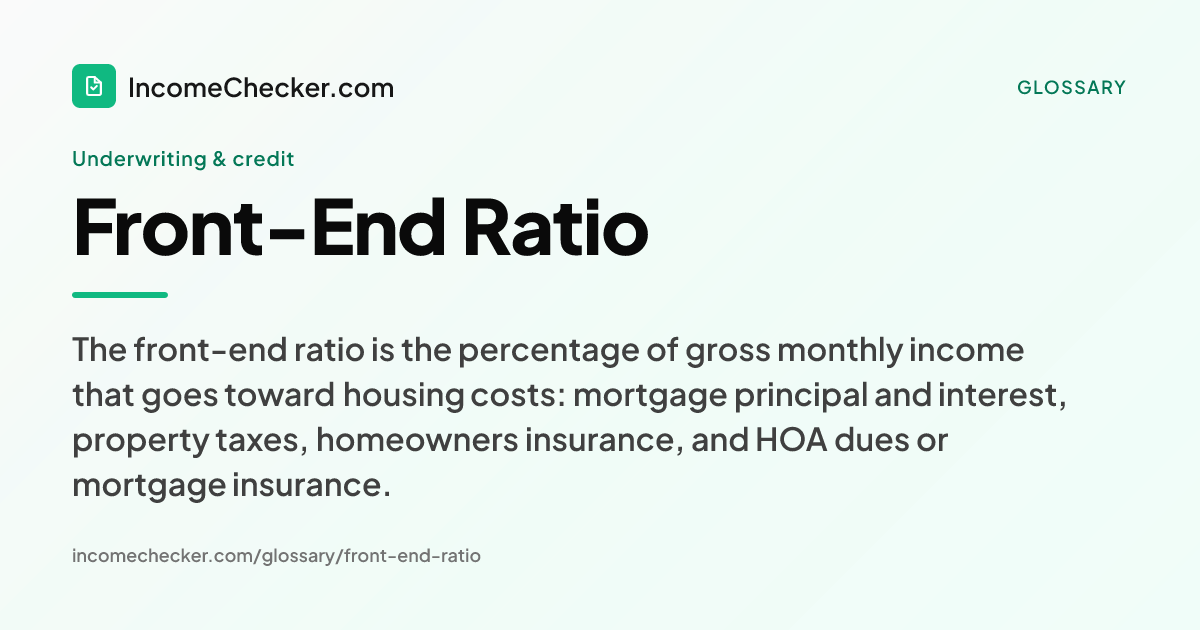
The front-end ratio is the percentage of gross monthly income that goes toward housing costs: mortgage principal and interest, property taxes, homeowners insurance, and HOA dues or mortgage insurance.
What does front-end ratio mean?
Front-end ratio = monthly housing expense ÷ gross monthly income. The housing expense is often abbreviated PITI (principal, interest, taxes, insurance), plus HOA dues and mortgage insurance if they apply.
Traditional guidelines put the front-end limit around 28% for conventional loans and 31% for FHA loans, though automated underwriting can approve higher ratios when other factors are strong.
For renters, the equivalent measure is the rent-to-income ratio.
Front-end ratio example
A buyer earns $7,000 per month gross. The proposed payment is $1,480 principal and interest, $320 property tax, $110 insurance, and $50 HOA dues, for $1,960 total. The front-end ratio is $1,960 ÷ $7,000 = 28%.
Related terms
- Back-End RatioThe back-end ratio is the percentage of gross monthly income used for all monthly debt payments, including housing, car loans, student loans, credit cards, and other recurring debts.
- Debt-to-Income RatioDebt-to-income ratio (DTI) is the percentage of a person’s gross monthly income that goes toward monthly debt payments, including housing, car loans, student loans, and minimum credit card payments.
- Rent-to-Income RatioRent-to-income ratio compares monthly rent with gross monthly income, usually shown as a percentage (rent ÷ income) or as a multiple (income ÷ rent).
- UnderwritingUnderwriting is the process a lender, insurer, or landlord uses to evaluate the risk of an applicant and decide whether to approve them, and on what terms.