Bank data & compliance
Permissible Purpose: Definition & Example
What Is a Permissible Purpose?
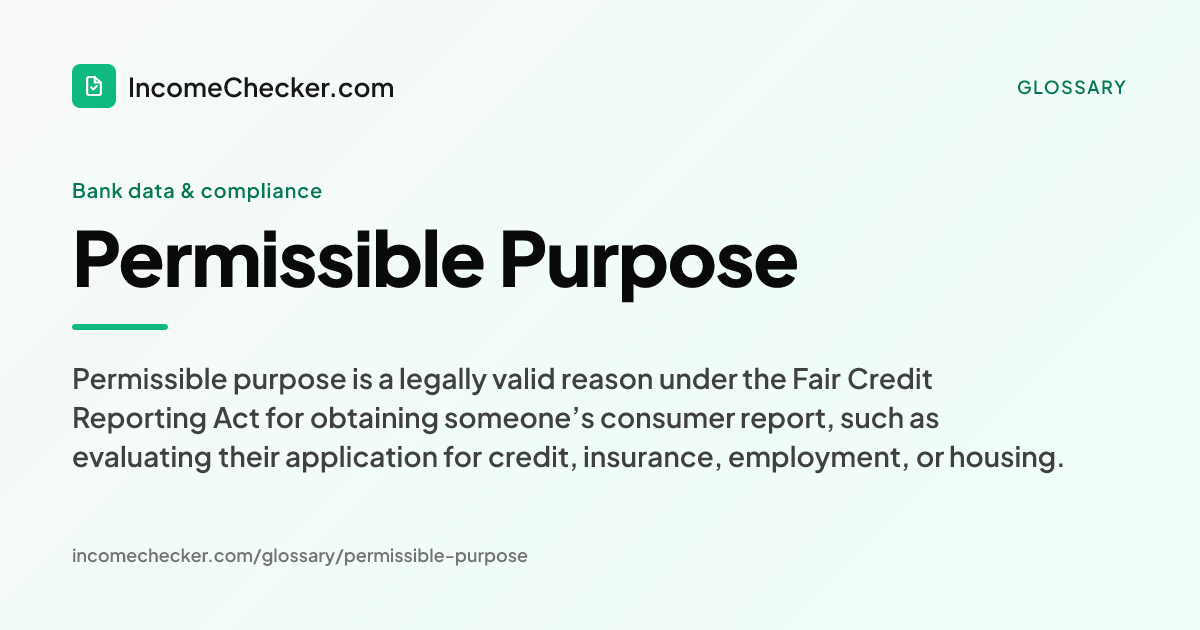
Permissible purpose is a legally valid reason under the Fair Credit Reporting Act for obtaining someone’s consumer report, such as evaluating their application for credit, insurance, employment, or housing.
What does permissible purpose mean?
The FCRA lists the purposes for which a consumer report may be obtained. Common ones include a credit transaction the consumer initiated, account review, insurance underwriting, employment (with written authorization), a legitimate business need in a transaction the consumer initiated, such as renting an apartment, and the consumer’s written instructions.
Pulling a report without a permissible purpose, such as checking a neighbor’s credit or screening someone who has not applied, violates the FCRA and can lead to liability.
Consumer reporting agencies must take steps to make sure their customers have a permissible purpose, which is why landlords are often asked to certify how they will use reports when opening a screening account.
Permissible purpose example
A property manager may pull a credit report on an applicant who submitted a rental application. The same manager may not pull a report on a prospective tenant who only toured the unit and never applied.
Related terms
- Fair Credit Reporting ActThe Fair Credit Reporting Act (FCRA) is a federal law that regulates how consumer reporting agencies collect and share consumer information and how others use consumer reports.
- Consumer Reporting AgencyA consumer reporting agency (CRA) is a company that regularly assembles or evaluates information about consumers and furnishes consumer reports to third parties for decisions about credit, insurance, employment, or housing.
- Tenant Screening ReportA tenant screening report is a consumer report a landlord orders from a screening company, usually combining credit, eviction, and criminal record information about a rental applicant.
- Soft Pull vs. Hard PullA soft pull is a credit check that does not affect your credit score, such as checking your own credit or a prequalification. A hard pull is a check made when you apply for credit and can lower your score slightly.