Income
Average Daily Balance: Definition & Example
What Is an Average Daily Balance?
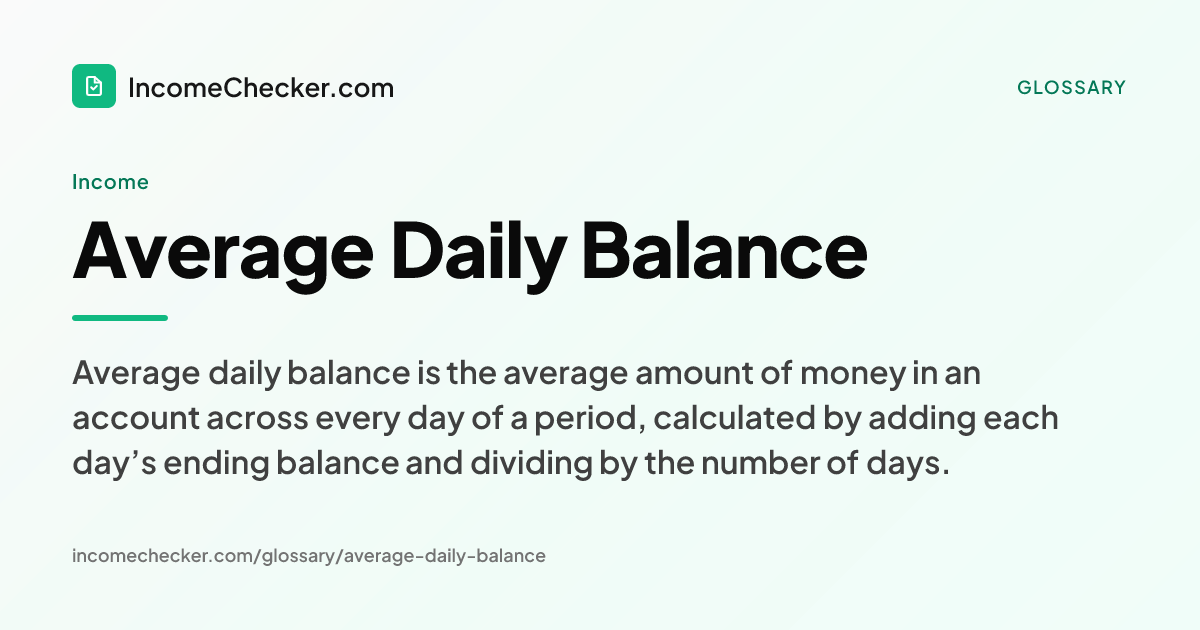
Average daily balance is the average amount of money in an account across every day of a period, calculated by adding each day’s ending balance and dividing by the number of days.
What does average daily balance mean?
Banks and card issuers use average daily balance to calculate interest and sometimes to decide whether monthly fees apply. Credit card interest is commonly charged on the average daily balance for the billing cycle.
In lending and income analysis, average daily balance shows how much cushion someone typically keeps, which a single statement-date balance can hide. An account can show $8,000 on statement day right after payday and hover near zero the rest of the month.
Business lenders, especially for merchant cash advances and small business loans, often look at average daily balance along with the number of days with a negative balance.
Average daily balance example
An account holds $500 for 10 days, $2,500 for 15 days, and $1,000 for 5 days in a 30-day month. The average daily balance is (500 × 10 + 2,500 × 15 + 1,000 × 5) ÷ 30 = $1,583.
Related terms
- Cash FlowCash flow is the movement of money into and out of an account, household, business, or property over a period. Positive cash flow means more money came in than went out.
- Liquid AssetsLiquid assets are cash and other holdings that can be quickly converted to cash without significant loss of value, such as checking, savings, money market accounts, and publicly traded securities.
- NSFNSF (non-sufficient funds) means a bank account did not have enough money to cover a payment, so the bank returned the check or electronic payment unpaid, often with a fee.
- OverdraftAn overdraft happens when a bank lets a transaction go through even though the account does not have enough money, leaving a negative balance that the account holder must repay, often with a fee.
- Bank Statement AnalysisBank statement analysis is reviewing a person’s or business’s bank transactions to estimate income, spot recurring expenses, check balances, and flag risks such as overdrafts or unusual deposits.